Wednesday, October 22, 2014

The Leadership Principle: Starfleet's Finest in the Captain's Chair, Part 2

In our last blog we discussed the leadership styles of Captains Kirk, Picard, Sisko, and Janeway and how each of them expressed their unique command abilities with respect to the starships they served. Let us now turn our attention to how each of these captains were a representation of the real-world times in which they were portrayed on the small, and in some cases, on the big screen.

Captain Kirk: The Fighter, the Hero, the Aggressive Commander


James Tiberius Kirk
These four captains' styles of command are as individual as they are, and, the Meditator believes, are all representative of the times in which they led their respective starship crews. Of all that we may contrast distinctly due to the era in which he commanded, Captain Kirk must stand alone for several key reasons. Captain Kirk's Enterprise represented a Starfleet in which the galaxy was less explored, human technology less developed, and, in my opinion, certain rules of Starfleet and starship culture were less strictly defined and enforced. Also, in Kirk's time the Klingons were avowed enemies, as were the Romulans. In other words, James Kirk lived in a Starfleet more aggressive than that of our other captains.

Consider: In 1960s America we were aggressively dealing with the Soviet Union and International Communism; race issues domestically, including riots and the Civil Rights movement; anti-war movements, such as that against Vietnam; and counter-cultural reactionism against the Establishment (Hippie "Flower Power" and "Free Love" are examples of that). All of these subjects were tackled in one way or another by the original series.

Yet even through these seemingly insurmountable problems, the America of the 60s represented a nation more confident of itself and its values than of today. It was a country more firmly centered in classical ideas of Western Civilization as they were then understood, and thus it was a nation that stood firm in its outlook, even when faced with external and internal turmoil. The Meditator affirms that such outlook was reflected in the 1960s Star Trek and personified specifically in the person of Captain James T. Kirk.

None of this is to say that James T. Kirk was a hyper-aggressive brute out to shed blood and start conflict any chance he got, but to illustrate how the personality of this superbly dynamic Starfleet officer reflected both his fictional and actual world environment.

The 24th Century Commanders: Thoughtful, Diplomatic, & Dynamic


Jean-Luc Picard
By contrast, the Starfleet of Picard, Sisko, and Janeway is a much more settled institution, with rules and regulations befitting that of a more organized and mature space exploration agency. Thus, in your writer's opinion, we see a far less cavalier and grittier Starfleet than we do in Kirk's time, at least on the surface.

Comparatively, the three 24th Century captains themselves were dramatized during less turbulent times in both the life of the American nation and that of the world as a whole. While Picard is perhaps the most cerebral and intellectual captain to date - possibly only being surpassed in that mantle by Janeway due to her scientific background - he nonetheless represents a calmer, more thoughtful, less aggressive Starfleet as a whole. Picard is emblematic of a Starfleet that is at overall peace with the known galaxy, and offers a more diplomatic perspective on the application of force than does Kirk.

Ben Sisko
In the real world, the Treks of TNG, DS9, and Voyager represented an America financially prosperous, internationally stable, and more or less socially cohesive on the homefront.

As an example let's briefly think about the first Gulf War which occurred during TNG's run in 1991. Here was a conflict that ultimately set the stage for the toppling of the Iraqi regime of Saddam Hussein in 2003. Yet, as historically notable as it was, Gulf War I paled in comparison to the monumental and world-altering 9/11/01. Indeed, 9/11 had not yet occurred even while Voyager was still on the air; in fact, Voyager had completed its seven-year run by the time September 11th happened. The last series to date, Star Trek: Enterprise, had the distinction of being on-air when the attacks took place, and of dealing with the event in a fictional counter-portrayal.

Even during the time of Ben Sisko and DS9, the Dominion War was not a representation of any real-world conflict of note, but a fictional portrayal of the ongoing expansion of influence of the human Starfleet and its interaction with the Bajoran and Changeling peoples. And though we might claim that out of all the 24th Century captains, Sisko was certainly the most passionate and dynamic, even this Starfleet officer tempered, and was tempered by, his environment and circumstances. In this regard, I've given considerable space to why I believe Sisko perhaps the most well-rounded character of the new captains. Please feel free to review it.


Kathryn Janeway
It is also worth noting that during the Janeway years, Voyager's encounters with the Borg Collective did not represent any major true-to-life events, but, once again, the continuation (and furtherance) of a conflict began with the introduction of the Collective in the TNG episode "Q-Who." The journeys of Captain Janeway and her crew to get back to the Alpha Quadrant were certainly interlaced with danger and hardship, yes, but represented the on-screen excitement of pure adventure and the exploration of space which Starfleet was created to advance. Does any of this mean that Janeway stood out less than Captain Kirk?

Does it mean that any of the 24th Century captains stood out less than Kirk because they occupied times that were less dynamic in their fictional portrayal of reality? The Meditator thinks not. Any and all of the 24th Century starship leaders proved beyond doubt that they were more than capable of holding their own and giving back as good as they got in all areas of starship command life. They proved that the Starfleet of their time was no less courageous, no less human than that of Kirk's. Indeed, Starfleet, like its captains on the bridges of their majestic vessels, had become more sophisticated and savvy about the universe and the wonders within.


This is the Captain Speaking...


Kirk, Picard, Sisko, & Janeway
The four Starfleet officers we've studied here represent profiles in character, courage, understanding, and leadership on multiple levels. And, in your writer's opinion, they show that the Treks of the late 80s through the early 2000s were quite in contrast to the societal upheaval taking place in the American 1960s or the economic and international uncertainty of today. The more aggressive and passionate Captain Kirk, and his Starfleet, was a reflection of the American times in which he was created. And so was Picard, Sisko, and Janeway, but from obviously different perspectives. Your writer reiterates that these captains' attitudes were a reflection of the real-world times in which they were portrayed.

What will the next Star Trek captain be like? One cannot say specifically, but if Trek tradition continues to hold sway, he or she will almost certainly be a mirror for the American and planetary condition of their time.


Until next time...


To the upward reach of man.


*******************

For those wondering: Why no analysis of Jonathan Archer and the crew of Star Trek: Enterprise? As before, when I first began this meditation, I explained in part one that I rarely watched this series when it was on broadcast TV (and still have not to this day) and thus cannot be as easily insightful with it as I can with the other Star Treks. Perhaps I will actually sit down and watch Enterprise from beginning to end one day and do for it what's been done in this group of meditations. We'll see.

Tuesday, October 21, 2014

The "Pretender" Phenomenon & Human Potential, Part 1, repost

This is a repost of a meditation on the late 1990s TV show, The Pretender. Do enjoy!

-- Subspace Meditator


There are Pretenders among us.

Geniuses with the ability to become anyone they want to be.

In 1963, a corporation known as the Centre isolated a
young Pretender named Jarod and exploited his genius
for their research.

Then one day, their Pretender ran away...


From 1996-2000, these were the opening theme words for the belated NBC TV series The Pretender. This TV program chronicled the exploits of a genius named Jarod who was taken from his parents as a child. Over the course of four years, the adult Jarod remembered and sought answers to who he was and where he came from. Simultaneously, the viewing audience was granted a unique look inside the world of a storied mastermind who could assume any identity, any personality, any skill set he chose within a matter of hours or days. Literally! From doctor to race car driver to insurance salesman to astronaut, Jarod used his innate gifts honed at the Centre to defend the weak and defenseless, and to empower the powerless.

For one hour every Friday, Jarod so completely became a fake personality that he was able to convince everyone from a restaurant cook to an FBI section chief that he was who he claimed to be. His talent represented a kind of total immersion into the new identity's world and environment, a total immersion that has been thought on by psychologists and others who are pushing the boundaries of what we know about the human brain and its capability.

In other words, though actor Michael T. Weiss' Pretender may have been nothing more than a fantastic character, there is science behind the fiction. Further, there may in truth have been (or be) factual personalities behind the imaginary one. And it is these investigations, and those real personas, and what they all together could mean for further unlocking human potential, which is the subject of this meditation.


The Fictional Pretender and His Equals

Let's begin with a profile of The Pretender program's fictional representations of this extraordinary talent.

Profile 1: Jarod


Life's a gift.

-- Jarod

Jarod
As stated, Jarod is the series hero and its primary focus. His abilities as a true, natural Pretender are portrayed over and over and consist of two distinct but very different aspects. The first is broken down into two parts. Part A of aspect one is Jarod's unique ability to eidetically remember every detail he's exposed to. This, in effect, refers to Jarod's capability to photographically recall places, events, sounds, smells, etc, with near-total recollection as he chooses them necessary to complete his task. Part B of the first aspect is Jarod's fantastic working memory, which refers to his ability to hold multiple transitory (or temporary) pieces of information in his mind for later manipulation and use.

The second aspect is Jarod's ability to mimic the skill sets and personality types of any kind of profession or work environment he chooses to infiltrate. As in our introduction, this gives Jarod the ability to act and talk (and most importantly to assume the skills and mentality of) a doctor, engineer, teacher, lawyer, mobster, race car driver, professional chef, FBI agent, etc. He's even become an astronaut! And all of these skills are assumed without Jarod setting foot in a classroom or learning from a professor. Jarod learns the skills he requires to accomplish a "pretend" through a process of total immersion into his target environment by setting up what the series calls "simulations." In the TV program, a simulation is a recreation (whether whole or partial) of an environment into which a Pretender wishes to submerge himself. Jarod often used such simulations to teach himself what he needed to know about a place or situation in which he'd never been before so as to prepare himself for the numerous possibilities that would eventually arise from his interaction within said situation. Additionally, it was clear from the TV series that Jarod used his simulations to prepare for what could not be prepared for - that is, those unanticipated variables that arise as a result of the human equation in any circumstance. Though it was rare, Jarod did encounter what the Meditator calls sub-situations of the main situation for which he was not ready. And it was at such times that Jarod's ability to "pretend" was most effectively seen, for this amounted to his ability to think on his feet, rather than merely pre-anticipating and pre-planning for every event. These scenarios were most often observed when, at the end of most episodes, Jarod had to escape, unrehearsed, from the relentless pursuit of his main nemesis, Miss Parker.

As we come to learn, these functions of Jarod's brain are governed by a unique genetic sequence which allows him to access such amazing capabilities and naturally become the kind of person he is. Fundamentally, then, genetics (conjoined with training and certain psychological manipulative techniques) are also the basis for much of the other Pretenders' capabilities we see over the course of the TV program.

Jarod, as a character, is unique in other ways too. During his time outside The Centre we come to learn that, as a result of his deprived childhood, Jarod is deficient in certain fundamental "growing up" experiences. He's never eaten cotton candy, had a stick of chewing gum. He's never gone to a carnival, played with coloring books, or for that matter had a toy set. Through these experiences and so many more, the viewer comes to learn that Jarod's innocence and naivete is the rationale for his actions. And from these the viewer gets, in a way, to recreate his or her own childhood through Jarod's eyes. And this makes Jarod both a sympathetic  and empathetic character, not only to children, but to others who are not as strong and resilient as he. Further, they highlight Jarod's desire to defend the weak and abused as being motivated by his time at The Centre where he learned that the simulations he performed as a child were often used to bring harm and suffering to innocent people. Once he escaped captivity his every pretend was to "make amends" by using his great ability to balance the scales of justice for those who could not find it on their own, and to bring justice to those who deemed themselves so powerful or so cunning as to be above it. Moreover, Jarod's strong sense of morality, despite all efforts to relieve him of it at The Centre, make within him a courageous personality who does not succumb to using negative means to gain his ends. In each of his pretends, Jarod always takes the high ground of action, never disobeying or breaking the law, even to bring others under the heel of its justice or to win it for those whom he has decided to help.

Profile 2: Kyle, the sociopathic Pretender


I decide who lives or dies.
-- the childhood Kyle in a session with Mr. Raines


Shockingly, we come to learn that Kyle is Jarod's younger brother also kidnapped by The Centre when they were just children. Raised separately at the facility, Kyle's training takes a very divergent path from that of his brother. Abused and tortured by the deranged psychologist, Mr. Raines, Kyle is trained to use his Pretender talent for selfish, manipulative, and destructive ends. When we first meet Kyle, we learn that he has escaped from a maximum security prison and even while inside was using his ability of mimickry to "talk like a doctor, a lawyer," and even to get a prison guard a sizable amount of money on his tax return. Ultimately, however, Kyle is trying to find those responsible for his kidnapping and imprisonment at The Centre, and to punish those he believes responsible for his mistreatment while there. This leads Kyle to finding Jarod after the latter discovers him free and on the loose in the real world working as an assassin.

As a Pretender what is interesting about Kyle is in fact his sociopathic indoctrination by Mr. Raines. Kyle's abilities to pretend are quite similar to Jarod's. In fact, it could be argued that there is qualitatively very little (if any) difference in their overall talent. However, as a pupil/subject of Mr. Raines, Kyle is trained to leave behind all traces of morality and empathy and to exercise his talents to pretend with complete and cold objectivity. The series demonstrates this in flashbacks to Jarod and Kyle's time at The Centre when both young Pretenders are using their skills in various assorted joint simulations. Kyle chooses to ignore the moral implications of the simulations while Jarod chooses to incorporate, or at least raise the moral angles. The choice to ignore the moral angles makes Kyle a much more dangerous target because - unlike Jarod, who chooses not to exercise his great mental gifts to harm others - Kyle has no compulsion against destroying that which he deems unworthy of his sympathy. If he had remained alive and free, it seems quite clear that he could have indeed taken a very serious fight to The Centre and those whom he believed personally responsible for his torment while there. The unfortunate loss, however, of Kyle was a heart-wrenching blow to Jarod - who was in a constant search for clues and ties to his past - and, the Meditator believes, a blow to the series in that Kyle as a Pretender, especially one without moral and ethical boundaries, would have made a great counterbalance to Jarod in his quest to bring justice to The Centre, its creators and allies.


Profile 3: "The Chameleon" Pretender, Alex


We are introduced to Alex in the made-for-TV movie, "The Pretender, 2001." This is the third Pretender program in which a gifted personality other than Jarod and Kyle is portrayed. However, unlike Jarod, the Pretender whom we come to know only as Alex is another sociopath with a vendetta against The Centre and society as a whole. Unlike Jarod - who is trained as a child by Sydney - and Kyle - who is trained as a child by Mr. Raines - we do not know if Alex was kidnapped and imprisoned by The Centre as a boy nor by whom he was instructed while there. We do know that Alex attempted to escape The Centre with Jarod and a fourth Pretender named Edward many years later in adulthood. Alex's escaped failed and he was recaptured and thereafter tortured and then assigned to an organization called the Triumvirate, a superior group to The Centre with whom the latter has intricate ties. Alex first comes to Jarod's attention when a series of taunting messages arrives from a villain identifying himself only as the Chameleon. Within these messages are coded statements ultimately revealing the Chameleon's true identity. Of course, the Chameleon's purpose is for only Jarod to understand their real meaning: revenge for what he believes was his abandonment at The Centre during their escape attempt many years prior. However, simultaneously, a string of odd murders also occur that leave behind clues which lead Jarod to suspect that the Chameleon exhibits superior adaptive skills which suggest Pretender traits. He goes on the hunt for the Chameleon disguised as an FBI agent. However, the Chameleon fights back, attempting to frame Jarod by using his own Pretender skills as the bait and switch. Ultimately Jarod finds and confronts Alex as the Chameleon, but not before Alex manages to kill their fellow Pretender, Eddie Ballinger. The startling factor in Jarod's pursuit of Alex is not his chase and cornering of Alex, but in the revelation Alex makes at Jarod's almost successful apprehension just prior to Alex's "suicide" at a water plant. He tells Jarod that The Centre has not been chasing him all over the country just because he's their prize Pretender; it's much deeper than that. Further, Alex tells Jarod that he will not give him the answers. If Jarod really wants to know the answers to all the secrets then Mr. Parker is the one to seek out. Alex then falls to his "death" in a watery grave dozens of feet below. But his body is never recovered, leaving the viewer to wonder whether - in true Pretender fashion - if Alex actually escaped alive.

Profile 4: The sub-Pretender, Eddie Ballinger


From what we know, the Pretender named Edward (Eddie) was taken from his parents, just as Jarod, when he was a small boy. However, according to Mr. Raines, Eddie, unlike Jarod, Kyle, or Alex, was not a natural Pretender. He was a "sub-Pretender" who was trained in the Pretender talent, but possessing obvious gaps and flaws in his abilities to pretend. This made Eddie less important to the work of The Centre, and when he escaped, the corporation did not pursue his recapture as it did that of Jarod, Alex, and Kyle. Eddie went on to make a life for himself as an NSA agent and family man, free to interact with society as he chose. He continued this life until his untimely reunion with Jarod years later, which ultimately led to his death at the hands of fellow Pretender, "The Chameleon," Alex.


Profile 5: the savant, Angelo


Angelo is not a Pretender, but a supernormal empath, created by Mr. Raines, who is capable of "absorbing" other individuals' personalities and feelings. Angelo was Mr. Raines' failed attempt to artificially create a Pretender from a subject lacking the natural talent to become one. Angelo's subsequent creation as a savant empath, however, was accomplished by first breaking down his real personality via electroshock treatment and drugs and then by "rebirthing" a new personality in the shredded mind of the old one. This combination of torture and drug abuse on the part of Raines somehow brought to life a personality within Angelo that allows him to literally absorb the emotional state of mind of an individual simply by looking at a possession of the target subject- such as something they wrote, drew, or even a long-held personal possession, like a watch. Angelo has used this ability to help The Centre track Jarod's location several times, but also, unknown to Centre personnel, has used his talent to secretly assist Jarod in eluding Centre capture by misleading them.


Now that we've covered some of the special personalities that made up the fiction of The Pretender series, in our next look at this unique program, we shall turn our attention to the science behind the fiction in an effort to understand whether there is actually any reality to the show itself.

I believe the answers we find will indeed amaze us.


Until next time...


To the upward reach of man.


Monday, October 20, 2014

The Leadership Principle: Starfleet's Finest in the Captain's Chair, Part 1, repost

I posted this meditation after a long consideration as to how to approach dealing with the monumental subject of some of Starfleet's best in the center seat of command. Here's a breakdown of four of the best reposted here at The Genesis Particle.

-- Subspace Meditator


In the Star Trek sci-fi universe there have been five well-loved series. In each of those series, five iconic Starfleet captains have commanded the bridges of mighty Federation starships powered by the imagination of their viewers. With this meditation, I'd like to use three of those five captains as a means to explore what is commonly called "the leader principle." Here, we'll examine what it means to be a leader through the eyes of the legendary Captains Kirk, Picard, and Sisko, and how each of these men inspired their crews through dynamic personal leadership. Furthermore, we'll look at what this means in the real world, and how we might each benefit from a study of these classic leader types, fictional though they may be. 

So, fellow officer, take a seat in the captain's chair as we jump to warp speed and begin.


James Kirk

"I don't like to lose."
-- Admiral James T. Kirk

Without question one of the most iconic science fiction heroes of all time is the legendary *first captain* of the Starship Enterprise, James Tiberius Kirk. Known as a man of action, Captain Kirk is a leader with presence who doesn't take no for an answer, and who doesn't suffer defeat gladly. As a young cadet, Kirk proved the latter by famously rigging Starfleet Academy graduates' most despised command test of all, the Kobayashi Maru, enabling him to become the only Academy superstar to ever beat "the no-win scenario," for as Kirk himself would say many years later, "I don't believe in a no-win scenario." 

How did he do it? "I changed the conditions of the test. I got a commendation for original thinking," he says to the inexperienced Lieutenant Saavik in The Wrath of Khan. Throughout the Original Series we see a Captain Kirk who time and again beats back death, beats back defeat, saving the day not only for (and with the help of) his gallant crew, but also for Starfleet's noble ideals, and the safety and security of the galaxy itself.

Yet even Captain Kirk is powerless to forever hold back the hand of fate. Twice in the original crew movie series James Kirk faces what for him become the ultimate losses in the form of the death of his most beloved friend, the Vulcan science officer, Mr. Spock, and the destruction of the one true "lady" in his life, the great Starship Enterprise herself.


"I Don't Like To Lose."

Yet even these "defeats" are not enough to break the man, the captain, the leader that is James Kirk, for, as Dr. Leonard "Bones" McCoy reminds him after the destruction of the Enterprise, Kirk always finds a means to "turn death into a fighting chance to live." He does it when the original Enterprise meets its end in The Search for Spock. And he does it when given the chance to return his best friend to life when it is discovered that Spock has been regenerated on the Genesis Planet.

What principles of leadership can we learn from Captain Kirk?

The greatest lesson I think Kirk shows us is that there is always a way out of a "no-win scenario." To find it takes courage, imagination, cunning, ingenuity, determination, and above all, the will to overcome. Captain Kirk demonstrated these traits repeatedly and in abundance during his Starfleet career, facing down many impossible scenarios - from military to diplomatic to scientific - and proving that the will to prevail shines brilliantly within the human spirit, and is capable of overcoming all obstacles if we are but willing to listen and heed it.

Of course there are many more leadership traits that we could examine with this heroic Starfleet commander. But our focus was to take his core traits and collapse in on a few key examples of how they make Kirk the man he is and why his example is worth emulating.


Jean-Luc Picard

"Make it so."
-- Captain Jean-Luc Picard

Following on the heels of his predecessor, the noble captain of the Starship Enterprise-D is our second model for consideration. Jean-Luc Picard is a renaissance man in the finest tradition of the term. Picard is a philosopher; amateur musician, painter, and actor; accomplished diplomat; skilled fencer; trained archaeologist; a student of history; an enthusiast of the natural sciences, particularly the astro and temporal sciences; and, of course, the highly respected and successful captain of the Federation flagship. He is a type of the best of the human species and of human potential which even the superbeing Q recognizes as true.

Picard exudes leadership by first demonstrating the best, and then demanding and subsequently expecting the best from his crew. He inspires his people to go out of their way for him because they recognize that they act in the name of the best Starfleet captain of the modern era. His example of thinking before action has led the Enterprise-D out of treacherous situations on multiple occasions. This is has been especially true in matters of interstellar standoffs where reflection, calm, considered judgment, and reason have prevented armed conflicts from ensuing - both military and political. And one of the greatest examples of Picard's ability to see the "big picture," to use his deep knowledge of the human condition to look down the long tunnel of history and avoid unwarranted bloodshed, is when fellow Starfleet captain Benjamin Maxwell unjustifiably attacks Cardassian territory to the end of preventing what he believes is a clandestine Cardassian military rearmament and future assault upon the Federation. Picard prevents Maxwell from taking Starfleet and the Federation to war against the Cardassian Union without the firing of a single shot against neither the rogue Starfleet captain nor the Cardassian forces. Yet Picard does not idly dismiss the warnings of Benjamin Maxwell, nor the evidence - albeit specious at best - which he has produced to support his accusations. Picard goes on, in diplomatic, but firm, unadulterated language to warn the Cardassians that Starfleet will be on guard.

Yet a second example is the defection of Romulan admiral Alidar Jarok. Moving to investigate an alleged plot by the Romulan Empire to provoke war, the Enterprise is requested to determine if the supposed evidence of apparent defector Admiral Jarok is true. Picard rushes into the Romulan Neutral Zone on Starfleet Command's orders only to discover that the Romulans have staged the entire affair using the duped Admiral Jarok as an unwitting pawn in a devious machination to frame the Federation. Though Picard is in direct violation of the Federation peace treaty with the Romulans, and though the Enterprise is completely surrounded by enemy vessels and cut off from escape, Picard demonstrates the forethought and superior understanding of Romulan psychology to prepare for such possibility well before entering Romulan space. He again saves the Enterprise from destruction, Starfleet from an unwanted conflict, and the Federation from intergalactic humiliation by the cunning use of a brilliant tactical counterploy alongside the Federation's interstellar ally, the Klingon Empire.

Though we have focused on two military examples of Picard's leadership, the core trait that Subspace Meditator sees - which is in fact demonstrated well and beyond Picard's skills as a military commander - is his ability to think through a situation deeply before taking action; his ability to see multiple possibilities and multiple probabilities, and further, to deduce from these the best likely scenarios with which to guide his crew to the successful completion of their mission. Alternately said, Picard has a well-honed ability - derived from years of experience as a field officer - to foresee a myriad of options and collapse in on the few (or one) that will bring the Enterprise home.

Subspace Meditator believes that, more than any other trait Picard manifests in the TNG era, this trait is what distinguishes and separates him from his counterparts in the Star Trek universe.

And a superior trait it is to have indeed!


Benjamin Sisko


"There's only one order... We hold."
-- Captain Benjamin Sisko


Of course, longtime fans of Trek film and TV will know that Benjamin Lafayette Sisko is not the first nor last individual of African descent to be shown in Trek programming, so his presence in this regard is not unique. What is unique in that regard is that he is the first to be regularly shown in Star Trek episodic television. And this opportunity gave actor Avery Brooks a unique canvass upon which to paint Ben L. Sisko. Let's return to that fictional canvass and highlight some of those areas as well as the leadership style and core traits that make Sisko who he is, and not simply as the "black captain," but as an outstanding Starfleet officer.  


Family Man & Intimate Friend

Though it is known from other Trek lore that Starfleet does not discourage nor mandate its officers from having families, Ben Sisko is the only officer ever featured in its mythology to actively have one. All other episodic captains have been single. So Sisko's relationship to his son, Jake, is quite unique to explore from a storytelling point of view.

But let's back up.

father and son, Benjamin and Jake Sisko
Sisko is not simply a single father, but a widower. Having lost his wife at the climactic Battle of Wolf 359 in which Starfleet confronted the Borg invasion of Earth, led by the Borg-transformed Jean-Luc Picard, when the DS9 series opens, we find an emotionally lost Commander Sisko struggling to come to grips with Jennifer Sisko's death, a transfer to a recently abandoned Cardassian base far from Earth, and a very young teenage son whom he must now raise alone. For the first time in Trek history we are given the chance to see what Starfleet life is like for the married and attached individual. The heartwarming aspect of the father-son relationship across the seven years is how both come to terms with the severance of the husband-son roles neither will ever have or play in the life of their deceased loved one again. Benjamin and Jake learn ever-the-more to lean on each other, both imparting lessons to one another just as real parents and children do. What is most satisfying about this relationship to the Meditator is watching the boy Jake mature into a young man. And what assists this satisfaction best is to see it through his father's eyes. Whether teaching his son to cook his own meals, or about the "fairer sex," or giving him lessons in what true courage on the battlefield (and in life) means, or whether it is teaching Jake to know and be true to himself - no matter what others' expectations are, including his father's - this relationship brings out the best of what it means to be a dad, a mentor, a friend. It is especially heartwarming for those of us who have shared this bond with our fathers. And instructive to those of us who have not.


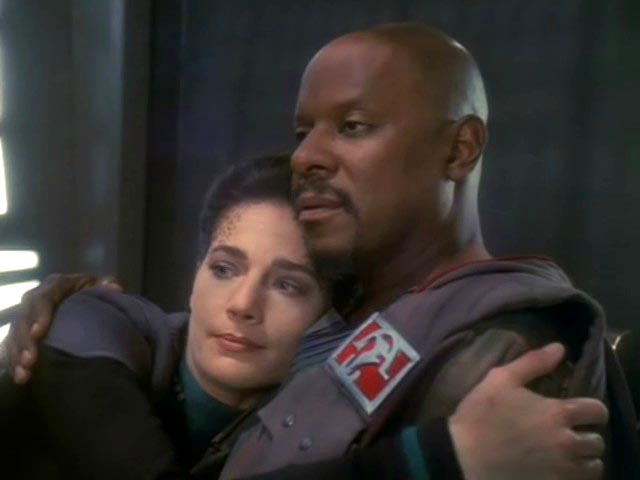
Jadzia Dax and Ben Sisko
The relationship of Captain Sisko to his son is only paralleled by the relationship to his Trill friend and mentor, Dax. We learn that the centuries-old symbiotic creature Dax is capable of assuming the host bodies of various individuals over the course of their lifetime. We also learn that the creature shares the experiences and memories of these persons, imparting to each new host the life lessons of the previous. As DS9 opens, we're introduced to the latest Dax host, Jadzia. Herself a trained scientist, the young Jadzia is recently bonded to her Trill symbiont, and reuniting with Sisko for first time in many years. She is pleased, as is he, to be joining her new superior officer in Starfleet's bold new venture to bring the recently-freed Bajoran star system into the Federation. She informs him that the previous Dax host, Curzon, has died, but that she shares his memories of a much younger and inexperienced Ben Sisko, and how Curzon mentored and shaped his worldview and future career. The relationship between Jadzia Dax and Sisko progresses over the next six years until Jadzia is sadly killed at the hand of Cardassian captain, Gul Dukat. What is fascinating, however, is that, before her premature death, Jadzia - in the form of her symbiont - continues to mentor the now much more seasoned Sisko. Yet, simultaneously, Sisko does his own mentoring of the young woman herself, returning the lessons in the form of experience she, as a being independent of her symbiont, has yet to have on her own. Across the breath of the series the contrast becomes quite satisfying as the viewer is given a glimpse of the extended family-friend relationship which the two have. 


Emissary to the Prophets

One of the most intriguing aspects of Ben Sisko is his special relationship to the Bajoran people themselves and to their deities, the Prophets. Known as the Emissary to the Prophets, Sisko is reluctantly introduced to the role Bajor will come to expect of him when he first arrives on DS9. As we learn, Sisko does not want it and is extremely reticent to assume the figure of religious icon to the deeply spiritual Bajorans. It is a part which Starfleet itself will always have difficulty accepting and which Sisko will continually struggle to balance between his life as an atheist human Starfleet officer and the need to strengthen the Federation's ties with the Bajoran people. Such a balance, though continually tested and uneasy, is achieved. And as DS9 continues, Sisko uses this special relationship, long ago foreseen and "prophesied" of by ancient Bajoran seers, to guide Bajor through some of it darkest hours. Sisko meets the Prophets on numerous occasions, joining them in the non-corporeal realm outside of time and space which they inhabit to consult with them, to receive guidance and instruction from them, and even to teach them on occasion what it means to be a creature that exists within time and space.


War Leader & Superb Strategist

Deep Space Nine became the focal point of the Federation Alliance's efforts to repel the Dominion invasion and occupation of the Alpha Quadrant during the Dominion War. On the front lines of this herculean effort was Ben Sisko himself. Tasked with planning and strategizing some of the fiercest engagements of the war, Captain Sisko led DS9 and Starfleet through the blood and horror of billions dead, but trillions liberated from the tyranny of the Changeling Founders' vision of order in the galaxy. The Dominion War was not an easy time for Sisko. Throughout this conflict the captain would not only see many of his crew killed, including Jadzia Dax, but his personal morality and principles as a human being and Starfleet officer would be put to the ultimate test more than once. He would see more conflict than he ever wanted and share in the pain, anguish, wrath, and sorrow of war all soldiers feel. Yet, leading his people through the conflagration, Sisko never lost touch with what it meant to be a man, a human being capable of seeing and feeling the human factor.


The Human Equation Not Forgotten

All of these roles serve to make Ben Sisko one of the most impressive characters and captains in Trek and Starfleet history. Indeed, it may be argued that he is the most unique persona to be conceived in the scope of the franchise. The above aspects of Sisko, Subspace Meditator believes, make him a much more well-rounded character, giving him an edge in observing, and applying, the human factor to all of his endeavors as a Starfleet officer. Sisko's humanity is never left behind, nor his mental and emotional state a mere afterthought. They are directly applied and demonstrated - indeed felt - whether in the loss of Jadzia Dax, the growing pains of his son, the struggles of the Bajoran people to rebuild after decades of slavery and occupation, or the triumphs and tragedies of the Dominion War. He is a complete man, making his leadership style an example of what it means to be a whole individual.


Special Profile: Kathryn Janeway


"Get this crew home."
-- Captain Janeway to Cmdr. Chakotay 


I wanted to include the captain of the Starship Voyager because one of the most unique aspects of Kathryn Janeway's appearance in Star Trek history - in my view at least - is, not that she's a woman, but that, of all the heroic captains portrayed in the five series, Janeway alone was a superbly skilled scientist and mathematician, in addition to being a Starfleet captain. This is depicted again and again in Star Trek: Voyager and is certainly impressive, for Janeway utilizes these skills on numerous occasions to keep pace with - and in fact surpass - her chief engineer, tactical officer, and many others whose scientific and technical skill our other Starfleet captains have merely relied upon to provide expertise.

As an aside, while her appearance as a female isn't unique for much the same reasons Sisko's isn't as a black officer, it would be remiss of us not to notice that, for the first time in Trek history, a female captain becomes regularly featured on the bridge of a Federation starship in the person of Captain Janeway, making her, just as Sisko, another Star Trek milestone.

It should also be noted that Janeway's epic seven-year struggle to return her crew to the Alpha Quadrant after Voyager is stranded in the distant and unexplored Delta Quadrant, makes her one of the most gallant and enduring Fleet officers to ever don the uniform. Janeway and Voyager are thrust into an unknown and dangerous space fraught with perils the likes of which no human eyes have ever seen before. And seventy thousand lightyears from home, she and her crew are the farthest any human vessel has ever traveled inside the Milky Way. In such conditions many would be tempted to give up, find the nearest habitable planet to settle on, and call it the next hundred years.

But Janeway does no such thing.

She pushes the Voyager and its crew to never settle for anything less than seeing Earth and the Alpha Quadrant again. The journey is not easy. Nor would Janeway, undaunted explorer she is, have it be. With none of the Federation's resources, none of Starfleet's armed might to back them up, Voyager does not set a direct, non-stop course for Earth, but takes many detours and assumes many missions, charting the Delta Quadrant, its uncounted species and dangers along the way.


USS Voyager's flight path for visual purposes. Far away in the vast reaches of space, Janeway never gives up.

Invincible Borg Fighter

Part of that legacy is Janeway's continued battles with the Borg Collective. Time and again assaulted by the ruthless and unmerciful will of the Borg to assimilate Voyager, Janeway adroitly, and with ever renewed vigor, finds new and innovative ways to confront and defeat them. But this is not only in terms of military strategy, for Janeway must also confront Borg cunning and maneuver in the person of the Borg Queen, she who is the Collective's central mind and governor. It is Janeway who defeats the Queen and takes from her the rescued assimilated human, Seven of Nine. Janeway who preempts Borg efforts to attack and defeat the superior Species 8472 while simultaneously preventing an invasion of the Milky Way galaxy by the aggressive race itself. It is Janeway who more than once thwarts the Borg Queen's efforts to assimilate weaker races, and who frees other assimilated drones from the grip of the Collective. And it is Janeway who destroys the Queen's entire transwarp hub complex, crippling the Borg's hyperspace routes throughout the entire the galaxy for decades.


"But You're a Mother to This Crew"

Q once called Janeway a mother to her crew, the woman who held Voyager's morale together through an array of impossible odds, keeping her people together as a family cast away on a stormy and tempest sea. And in some ways the Meditator can agree with Q's praise and his comparison, especially in observing the nurturing relationship between Janeway and Seven of Nine. But beyond such accolades, Janeway is a proven leader with the skill, the tenacity, the drive to succeed whatever the odds, and no matter how insurmountable they may seem. This drive places her in the best ranks with the elite of Starfleet's center chair commanders. Indeed, the Meditator says that USS Voyager's seven-year odyssey revealed Captain Janeway's strengths in a way that mere service in the Alpha Quadrant would never have. It raised the honorable captain's pedigree because it forced her to run faster, reach higher, strive harder, never quitting until the race was won. This is the finest of Starfleet tradition and Kathryn Janeway is in numerous ways an exception to advancing that tradition!

And this, the Meditator thinks, is the principle lesson to be learned from Janeway: that to be the best one must step out of the norm, the familiar, the comfortable. One must go beyond the acceptable and known, casting away fear, and sweeping boldly into what is unknown. If an individual can do this, is willing to do this, they can distinguish themselves in human history. Captain Janeway most certainly did!


In our next blog on the four captains, we shall compare and contrast their style of leadership and what we can continue to learn from these examples with respect to how each fit in with their era on the small screen.


Until next time...


To the upward reach of man.


------------------------------------

*I know that some of you hardcore Treksters will say that J.T. was not the very first captain of the original Enterprise. Chris Pike was. Some of you will even go back to Captain Robert April. Guess what, Trekkies? I know that! I'm a Trekkie too! But for the sake of argument and popular knowledge, I am listing James T. Kirk as the first acknowledged skipper of the Enterprise, OK?

**I did not include Captain Jonathan Archer in this analysis simply because I did not watch the show with the same frequency or intensity as I did that of the others. So I cannot be as readily insightful with respect to Archer's boat as I can with Kirk, Picard, Sisko, or Janeway. Sorry Enterprise fans.

Friday, October 17, 2014

The Sith, the Jedi, the Ancient Force Religion, & the Two Great Struggles of Human History, Part 3, repost

This is the final installment of the "Sith, Jedi" meditation. Enjoy!

-- Subspace Meditator


The ideas expressed as part of this blog are my own and in no way represent the beliefs of Star Wars creator, George Lucas. Any coinciding opinions as to the relationships between Communism, Nazism, and Star Wars are incidental for I do not claim to know Mr. Lucas' thoughts on these matters.

In our last meditation we discussed two supreme examples of the struggle between good and evil, liberty and tyranny, and the darkness they heaped upon the world in the mid part of the 20th Century.

We will now turn attention to the lessons that can be gleaned from the Communist-Nazi advance upon Planet Earth and what and how Star Wars can help us to think about the real world with respect to them.


The Calculus of Power: Great Ambition, Great Power, Great Deception, Great Destruction


Great Ambition


A villain of history possessed of great ambition
The above subtitle's calculus isn't meant for sport, but for analysis. Many times in Star Wars, as in other great morality and human condition tales, those possessed of awesome power, or the potential to gain such, are generally more tempted (not less) by its acquisition. The Jedi and Sith are the most poignant examples in the SW universe. And these examples are culminated in the rise and ultimate tragic fall of Anakin Skywalker, he who was to bring balance to the Force.

But we get ahead. Naturally, any amateur student of history recognizes the picture to the right - that of leader of Nazi Germany, the Fuhrer, Adolf Hitler. I do not exaggerate when I call him a villain of history, for Adolf Hitler's ambition and leadership cast Germany into a living hell of destruction and infamy on the world stage. He brought what was once considered the most civilized and advanced nation on the European continent to devastation and laid it low in reputation and honor.  

Why?

The explanation, I believe, begins with the German people's humiliation at the end of WWI, and the consummating promises of the Nazi party once it had risen to power. So, on a greater level, Hitler's rise was facilitated, not by his showmanship or grandiloquent oration alone, but by a fusion of the German people's desperation and fear, and Hitler's own unbridled belief in himself as their savior. This megalomaniacal ambition is the first of our calculus and here deserves the reader's thinking, for the Jainist says that great ambition - unchecked by principle and by truth - leads to a lust for unbridled power. And it is to power that we will turn our attention next.

Great Power


A villain of history invested with great power
I have no doubt that you also recognize the face to our left. Josef Vissarionovich Jugashvili, aka Josef Stalin, was absolute ruler of the former Soviet Union for almost thirty years. His death brought with it an end to decades of Red Terror (at least under his rule), poverty, and uncounted suffering. The power of this man went unchallenged in his time, and was only brought to an end when he died an ignominious death in March 1953. What brought this man to the leadership of the Russian people and its satellites so as to invest both he and the Union of Soviet Socialist Republics, which he cemented together, into being?
A host of factors can be examined - from Stalin's early "tutelage" under Vladimir Lenin and the Bolshevik "Reds," to his background work in the party then led by Lenin and Leon Trotsky, to ultimately his seizure of power at Lenin's death and Trotsky's forced exile and eventual assassination. However, though all of these factors played a role in Stalin's eventual rise to general secretary of the CCCP, what is of interest to us in our examination of the Calculus of Power, is Stalin's use of guile, cunning, deception, and maneuver to capture and remain in supreme power despite more than twenty years of failures as leader of the Russian people and the Soviet Union as a whole. From the Great Famines of 1932-1933 to the Great Purges of 1936-1939, the power of Josef Stalin to command the Soviet people was unparalleled. Using fear, intimidation, and murder, Stalin captured not only the obedience of Soviet citizens, but their hearts as well! This is no more poignantly demonstrated than when millions of Russian and Soviet citizens literally wept bitter tears upon the announcement of his death, an announcement that should have brought with it torrential waves of celebration and shouts of "Hoo-ray!"

Again, we see that it is not merely one man alone who takes his ambition and uses it to sow unto himself power of his own accord, but the social construct of those human beings around him, in both private company and public society, who invest within him their own desires, fears, and needs, then using the persona of his authority to gain for themselves the secret wishes of their hearts. Once this investment is made by such hungry, such needy, such desperate people, and once it is captured by the ambitious "Fuhrer," the ambitious "Leader," no amount of skulduggery, no amount of treachery is too low for such debased peoples to ignore.

Let us now return to our calculus within the fictional realm of Star Wars.

Great Deception 


"The goals of the grand plan [of the Sith] were
revenge and the reacquisition of galactic power."
 -- from the novel, "Darth Plagueis"

Count Dooku, aka "Darth Tyranus," greatly deceived
The Serenno-born noble, Count Dooku, was once a revered knight of the Jedi Order. Strong in the Force, and hailed as one of the brotherhood's most noted lightsaber duelists second only to Yoda and Mace Windu themselves, he succumbed to the Dark Side after several fateful decisions by the Jedi Council left many of his fellow Jedi dead or themselves seduced by the Dark Side during the Clone Wars. Deceived by the influence of the concealed dark lord, Darth Sidious, Dooku left and betrayed the Jedi and the Galactic Republic further into the Clone Wars years through a series of political and military subterfuges designed by Chancellor Palpatine/Sidious to bring about the grand-ultimate plan of the Sith.

What is of interest to our discussion regarding Dooku is how his great affinity in the Force, and his great knowledge of both politics and power, were used by the wily Palpatine to trick him into his own demise and, ultimately, that of the Jedi and the Republic. Dooku's "beef" with the Jedi was the selling point used by Palpatine to lure the once-sterling knight into a web of, first, self-deception and pomposity, and, then, into a trap of mega-proportions which ensnared and then overthrew the Jedi Order and the entire Republic itself. Dooku was deceived, but not simply by Palpatine, but by his own arrogance - an arrogance that led him to believe that he, using the power of the Sith in the person of Palpatine, could transform first the Jedi and then the Republic into his own grand vision of order and justice. It was that arrogance, nurtured by Sidious, which led to the eventual destruction and death of the late Master Dooku.

The lesson to be gleaned from Dooku's fall is that deception - particularly self-deception concerning one's own perceived knowledge and insight - can be one's own worst enemy. The Biblical warning that, "Pride goes before a fall, and a haughty spirit before destruction," may be aptly applied to the late count. Further, we may also state that the idea of the ends justifying the means is a perverse and treacherous slope on which even the most learned and wise navigate at their own peril. Dooku learned this lesson in the most painful of ways.
And this leads us to the final variable in our Calculus of Power.


Great Destruction


Sith lord Darth Vader, greatly destroyed
In many ways, Anakin Skywalker, aka Darth Vader, is the sine qua non of our calculus, for it is he who embodied these qualities both separately and all at once. It is not necessary to tell the full tale of Darth Vader's rise, from his miraculous birth on Tatooine to his becoming a young Jedi padawan, forward into maturity, to his ultimate seduction by Palpatine and fall to the Dark Side.What is of note to us is how Anakin/Vader is, once again, used by the cunning Palpatine to accomplish the goals of the Sith. In a brilliant longterm strategy, Lord Sidious targeted a young and vulnerable Anakin, from early childhood through his very turbulent teen years and on into adulthood, for conversion to the Dark Side.

Throughout Episodes 1-3, we are introduced to an extremely powerful Force sensitive who will become known in Force prophecy as "the Chosen One." It is this lofty responsibility that Anakin Skywalker carries upon his shoulders for the rest of his life.

But life circumstances rend a canyon of conflict in the young Anakin - conflict that is seen by Palpatine early on. Unwillingly separated from his mother as boy, Anakin's loyalties and sense of duty are then always divided. Hot-tempered and impulsive, arrogant because of his abilities in the Force, the growing young Skywalker is not yoked in the ways of peace and serenity that so characterise the Jedi. And this is despite all efforts to train and root him in the Order's ancient precepts. It is these traits that Palpatine will use to tempt and then bring about Skywalker's fall as a grown man.

How?

By using a possible vision of the death of Anakin's secret spouse given to both himself and Anakin by the Force - Republic senator Padme Amidala.

Palpatine informs Anakin that only the power of the Dark Side can save Padme's life, that the Jedi are unwilling, and more, incapable of saving her. Only by joining his destiny as the Chosen One with Palpatine's as the master dark lord of the Sith can Anakin hope to preserve Padme from a premature death.

But once Palpatine is exposed to the Jedi as Darth Sidious, once his machinations for the galaxy are revealed, and the Jedi move to stop him, Anakin, in an act both of self-deceived hubris and desperation, protects Palpatine from destruction only to be told by the dark lord that he has no answers as to how to save Padme Amidala's life! This is the ultimate betrayal! for now, not only has Skywalker sworn fealty to Sidious, but he has, in the doing, murdered a Jedi master and become complicit in the destruction of the Jedi Order and the Republic.

In order, then, to seek the power he desires, Skywalker justifies his actions by going deeper into the morass that Palpatine has designed for him. He attacks the Jedi temple, massacring hundreds of Jedi, including children. He personally murders the leaders of the Trade Federation on Sidious' orders, paving the way for Sidious to take over the Republic - converting it into a starspanning Empire under his direct and supreme control. He attacks and fatally injures Padme Amidala, the very woman he loves and seeks to save. And, in the end, Skywalker, battles his former teacher and friend Obi-Wan Kenobi in a lightsaber fight to the death on the lava planet Mustafar.

Skywalker is hideously mutilated and scarred in the battle, defeated by Kenobi, yet left alive to suffer the fate which Skywalker had so haughtily prepared for himself.

Thus Darth Vader is born and slaved, of his own twisted lust for power, to the eternal service of Darth Sidious. And it is only by the struggles of his future son, Luke Skywalker, some thirty years later, that he is finally redeemed from this great fall.


Our Lessons?

What may we learn of the great struggles of history from this calculus within the Star Wars framework, and how may we apply them to the real world?

One lesson is that, as Lord Acton, once cleverly stated: "Power tends to corrupt, and absolute power corrupts absolutely."

Another is that power, in order to be as divested of abuse as possible, must be diffuse. That is, it must be divided into as many segments and spheres of authority as will appropriately permit its lawful and efficient performance. As the American Founding Father Thomas Jefferson recognized: "In questions of power let me hear no more of confidence in man, but bind him down from mischief by the chains of the Constitution." To expound upon Jefferson, and to add in Acton then: most power, invested in the personages of a few individuals tends to consolidate corruption. And yet, all power, invested in the person of one individual alone will most certainly bring about despotism and tyranny. To avoid this situation, a people must compose laws consistent with their history, culture, and tradition which limit and bind the ambitious from capturing and holding power with impunity.

Yet a third lesson is that evil, whatever its form, must be vigorously opposed in order for life, and light, to prosper. It must be stood up to with, in the words of the great song, "A British Tar," 'an energetic fist' that is 'ready to resist a dictatorial word.'

And in the case of the Communist-Nazi advance upon Planet Earth, as in the case of the Sith advance upon the Jedi and the Galactic Republic, we have the examples of good vs. evil and liberty vs. tyranny that finally had to be opposed and overthrown so that human dignity and destiny could be realized.

So that truth could be the victor.

There are, of course, more lessons. But I will leave those, dear reader, for you to meditate on, as I have.

As always, we at Epoc Enuma SF test the notions of speculative fiction against the real world in hope of aiding you to see how these "far away" ideas apply to the living, breathing universe we inhabit, and how, in fact, they are not so far away after all.


Until next time...


To the upward reach of man.


Thursday, October 16, 2014

The Sith, the Jedi, the Ancient Force Religion, & the Two Great Struggles of Human History, Part 2, repost

This is the second installment of the "Sith, Jedi" series in which I meditated on the struggle between freedom and tyranny articulated in part, I believe, in the Sith-Jedi conflict of Star Wars fame.

-- Subspace Meditator


We began this meditation discussing what I believe to be the two great struggles of human history and their manifestations in the fictional universe of Star Wars between the Force factions of the Sith and Jedi Orders. To reiterate, the two great struggles of human history are those between good and evil, and liberty and tyranny.

Now let us turn our attention to two real-world great struggles which I will use as examples of this understanding.

Two Great Struggles in History: Totalitarian Collectivism at its Worst

In the 20th Century humanity was confronted with two of the greatest forces for evil in the history of the earth. I refer to the movements known as National Socialism (Nazism) and International Monolithic Communism. In this section, the Jainist will show you, dear reader, in a brief and broad sense, how these two absolutist forms of collectivism are very much more similar than one may think. Further, as we continue, I will show you that the ideological foundations for both these totalitarian monsters were in fact the same.

So let's begin.


Nazism

Let us consider the actual, worldly Jew -- not the Sabbath Jew...but the everyday Jew. ... What is the worldly religion of the Jew? Huckstering. What is his worldly God? Money. Money is the jealous god of Israel, in face of which no other god may exist. Money degrades all the gods of man -- and turns them into commodities. The bill of exchange is the real god of the Jew. His god is only an illusory bill of exchange. The chimerical nationality of the Jew is the nationality of the merchant, of the man of money in general.

-- Karl Marx, "On the Jewish Question", 1844

One of the most misrepresented ideas is that Hitler and the Nazi regime started "the Jewish Question." This is farcical, as the above quote, given by modern ideological socialist founding father, Karl Marx shows. Note that his statement is 95 years before the outbreak of WWII.

It should be further understood that Adolf Hitler himself often declared that much of the doctrinal basis for Nazism originated with the ideological beliefs of Marx. Many are unaware of this truth. However, read this 1925 New York Times article in which future Nazi minister of propaganda Joseph Goebbels states his belief that the difference between the "Hitler faith" and that of communism is "very slight." Goebbels' statement is an eye-opening revelation within itself. But let's look deeper, for there may be further hidden truths to the notion that the difference between the "Hitler faith" and the communist faith is "very slight."

Many are also unaware that for at least a decade before the advent of World War II, Communist Russia was already practicing industrial-scale murder in the form of both outright murder and genocide vis-a-vis starvation. For example, during the years 1929-1934 more than 2.7 million people were starved to death by the genocidal polices of Josef Stalin. This figure does not count the 7 million - MILLION - who died in 1933 alone because of Stalin's practices of food confiscation from, and then isolation of, the Ukraine.

If one adds these figures altogether, a total of greater than 9.7 million human beings lost their lives to the deliberate Stalinist practice of the Ukrainian famine of 1929-1934.

Moreover, the evidence of wholesale murder in order to suppress ethnic peoples inside the Soviet Union, and to restructure Soviet-communist society worldwide, is indisputable.

Sickening, isn't it?

Yet, these works of murder and starvation were studied by the Nazis before they ever began to contemplate "the final solution" to "the Jewish Question" inside Germany.

Think about that.

Soviet Russia taught the German Nazis how to be a more efficient force for killing. Nazi Germany did not, entirely, invent these practices on their own. They learned from their elder brother, Soviet Russia!

Coincidence?


Not hardly.


Communism

A revolution is certainly the most authoritarian thing there is; it is an act whereby one part of the population imposes its will upon the other part by means of rifles, bayonets and cannon, all of which are highly authoritarian means. And the victorious party must maintain its rule by means of the terror which its arms inspire in the reactionaries. Would the Paris Commune have lasted more than a day if it had not used the authority of the armed people against the bourgeoisie? Cannot we, on the contrary, blame it for having made too little use of that authority?

-- Friedrich Engels, "Controversy with the Anarchists", 1873

To denigrate violence as something to be rejected, when we all know that in the end nothing can be achieved without violence!

-- Friedrich Engels to Wilhelm Blos, (Letter, February 21, 1874)

Comrades!... Hang...no fewer than one hundred known landlords, rich men, bloodsuckers ... Do it in such a fashion that for hundreds of kilometres around the people might see, tremble, know, shout: "they are strangling, and will strangle to death, the bloodsucking kulaks."

Yours, Lenin.

-- Lenin's "Hanging Order" regarding the kulak revolt in the Penza Gubernia, August, 1918 

  
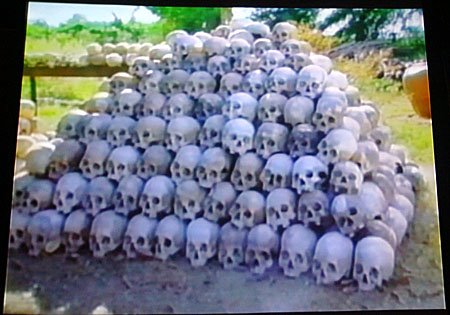
The red fist of Communism smashed down the lives of more than 100 million people worldwide. It left a bloodtrail of death from the Ukrainian famine/genocide of 1932-33 under Stalin to the Cambodian Khmer Rouge massacre of 1975. The theory of Communism has always been that once bourgeois capitalism has been overthrown, mankind could make way for the true and just governance of the proletariat and the classless basis of society. However, every time this "theory" has been practiced anywhere in the world, always the iron fist of dictatorship has followed. And such dictatorship has been loosed upon the world in the form of the unbridled murder and wholesale slaughter of innocents. There are those who say that what Lenin initiated in Russia in the early 20th Century, and what Stalin subsequently continued (and then exceeded by lightyear jumps) was not communism. That what these men did in terms of the murders of millions of people was an aberration - not in any sense of the word "communist." After all, Communism is about equality, peace, brotherhood - not murder.

The truth about Communism
However, the Jainist states emphatically that the bloodthirsty history of Communism, from its inception, is the actual fruit and reality of Communism! Indeed, dictatorship and murder, not equality, is Communism! That actual history, as stated before, can be seen in the slaughter of millions of human beings planetwide from Eastern Europe to Africa to Asia to Latin America. No Communist "theory" about "true" Marxism-Leninism substitutes for the reality of death pursued in the name of this so-called brotherhood movement.

But what is the basis for this pursuit in both Nazi and Communist philosophy? Why is killing an essential ingredient in the creation of the Nazi and Communist man?

The Nazi-Communist's "New Man": The Doctrinal Basis for Dictatorship & Killing

 ...there are times when the interests of the proletariat call for ruthless extermination of its enemies in open armed clashes.

-- V. I. Lenin (“Lessons of the Commune,” Collected Works, Vol. 13, p. 478)

The historical record is quite clear: once the Communist technique of subversion had run its course, and once the Communists had come to power in any country - it didn't matter where - they then proceeded to ruthlessly restructure the society by imprisoning, exiling, or outright murdering at least ten percent of the population. This included landowners, intellectuals, teachers, scientists, and especially those who resisted the Communist takeover, or, in particular, those who aided it to seize power in the first place.

One may ask, "Why? Aren't these some of the best people who would be needed to help rebuild the society and inoculate it against bourgeois ideas?"

A valid question.

But one which misses the more subtle point of Communist control. The point is to capture the minds of the target population by subjugating their will to the control of communism. The further point is to socially engineer the society so as to make it "more fit."

"More fit for what?" you ask.

Another valid question.

And here is the answer.


Ignore for a moment that this video focuses on Chinese communism. What I want you to get from this is Communism's assertion that it is the supposed answer to the ills of the world, and that its formula for the creation of a new society, a new kind of human being freed from the oppression of selfish individualism, is the correct model for the salvation of the world. And in the fuller context of the Communist "new man," we are to see from this video that it is society, as a whole, which has benefited from the enforced dictatorship of the proletariat. And because the people have not yet come to the realization that they must be lead to the paradise of egalitarianism, an enlightened few will act in the name of the greater masses of the people and lead them to paradise on earth, by force if necessary. For the greater good. This includes killing those who resist coming into alignment with the new reality imposed by the proletariat dictatorship, because, after all, they are too ignorant and set in the fallacies of the old ways to see the truth. They cannot be changed. And thus they must be eliminated, for their own good. And for the greater good.

But what is the Nazi counterpart to this idea?


While Communism preaches the notion of a new man based upon a false sociology, Nazism was equally interested in creating a new man based upon a false biology. We all have been taught to recognize the phony Nazi idea of the superior Aryan man, and thus the Jainist thinks there no need to quantitatively explain it to the majority of you. Suffice it to restate, however, Hitler's notion was that his "faith," as Goebbels put it, would create a new, superior form of life based upon the eradication of biologically inferior human beings. These humans expressed their biological inferiority culturally, intellectually, socially, even spiritually, by their inability to advance civilization, to defend themselves against "the stronger race(s)," and most significantly, by their inability to impose their way of life on the rest of the world. Planet Earth, therefore, belonged to the Aryan ubermensch and no one else.

Thus, in both Nazi and Communist philosophy we see the seeds of totalitarian control rooted in a false understanding of human nature. Both movements disagree with the human being as he or she is constituted. Both philosophies are at war with human nature as it is. And thus both ideas believe that if the enemies of the new human man do not give up, do not submit, they must be exterminated -- without mercy.

However, where did these two totalitarian siblings get their principles from? Modern-day Marxist apologists would have us believe that Hitler got it all wrong when he supposed to exterminate whole groups of people based upon their racial and national distinctions. But is this the truth?

The Jainist says NO! In point of fact, if one examines the writings of Marx and Engels, the Jainist says that Hitler indeed correctly interpreted the founding fathers of his philosophy.

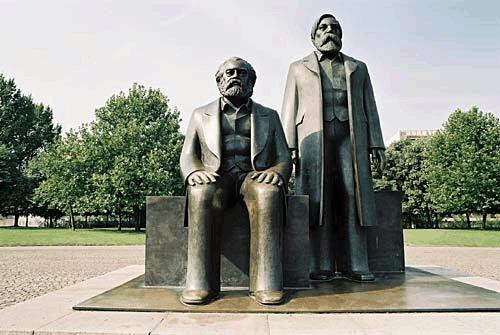
Marx and Engels: Believers in the Universal Brotherhood of Man?


Don't get your briefs in a twist when I tell you that nothing can be further from the truth! Both Karl Marx and Friedrich Engels were entrenchedly prejudice - not simply against black Africans or their descendants as is often asserted, but of Jews, Slavs, and many others. Observe just a few quotes.
________________________________


Two villains of history

This young lady, who instantly overwhelmed me with her kindness, is the ugliest creature I have seen in my entire life, with repulsive Jewish facial features.

-- Karl Marx to Antoinette Philips (Letter, March 24, 1861)


****
...the Jewish Nigger, Lassalle... it is now completely clear to me that he, as is proved by his cranial formation and his hair, descends from the Negroes from Egypt, assuming that his mother or grandmother had not interbred with a nigger. Now this union of Judaism and Germanism with a basic Negro substance must produce a peculiar product. The obtrusiveness of the fellow is also nigger-like.

-- Karl Marx to Friedrich Engels (Letter, July 1862), in reference to his socialist political competitor, Ferdinand Lassalle
****
Russia is a name usurped by the Muscovites. They are not Slavs; they do not belong to the Indo-Germanic race at all, they are des intrus [intruders], who must be chased back across the Dnieper, etc.

-- Karl Marx to Friedrich Engels, (Letter, 1865)

****
We discovered that in connection with these figures the German national simpletons and money-grubbers of the Frankfurt parliamentary swamp always counted as Germans the Polish Jews as well, although this dirtiest of all races, neither by its jargon nor by its descent, but at most only through its lust for profit, could have any relation of kinship with Frankfurt.

-- Friedrich Engels, Neue Rheinische Zeitung, April 29, 1849 
****
As for slavery, there is no need for me to speak of its bad aspects. The only thing requiring explanation is the good side of slavery. I do not mean indirect slavery, the slavery of proletariat; I mean direct slavery, the slavery of the Blacks in Surinam, in Brazil, in the southern regions of North America. Direct slavery is as much the pivot upon which our present-day industrialism turns as are machinery, credit, etc. Slavery is therefore an economic category of paramount importance.


-- Karl Marx to Pavel Vasilyevich Annenkov, (Letter, December 28, 1846)


Now put your fists up and praise your ideological fathers, ye black, Asian, Latin, and other non-Germanic, non-white Communists and socialist laborers for the dictatorship of the proletariat, the dictatorship of the master race, these men who hated you with all the vitriol and passion within their being!


The Specter Haunting the World


Marx, Engels, Lenin, Stalin, Mao
These men set the world stage for a century and a half of bloody totalitarian slaughter that has been unequaled in all planetary history. The specter haunting the world, to paraphrase Karl Marx, was not free markets, the rich, the middle class, nor those who create wealth.

The specter haunting the world is collectivism in all its heinous and destructive forms. The specter haunting the world is fascist socialism. And the specters of Nazism and Communism were its worst adherents in the history of the earth.


How Do These Two Philosophies Relate to Our Primary Thesis?

The Jainist doesn't believe there to be too much question in most people's minds that both Nazism and Communism represented two of the greatest forces for evil and tyranny in the history of the world. In fact it is my personal belief that International Communism was the worst of these two, and that it was the most heinous personification of evil ever faced by humankind to date.

Do not misunderstand.

I have no love for Nazism whatsoever!

I simply believe - based upon my own studies of the shear quantity of people killed, and the long, extended international reach of Communism, coupled with the fact that it was a more insidious, sophisticated, and subtler form of tyranny, and, finally, that the Nazis learned much of their techniques of enslavement from the Communists - that the international Red Menace was a far greater threat than history has given it credit for being.

To state my conclusion, however, Communism and Nazism, despite revisionist and apologist claims, destroyed the lives of nearly 130 million people combined. Nazism learned from its senior blood brother how to carry out the socialist cause, and Communism both preceded and succeeded Nazism in this endeavor long after the "Hitler faith" had been put down.

Both movements proved themselves a rabid, wild dog dedicated to conquest, murder, and domination.

If an individual can look at these atrocities and not regard them as acts of evil and tyranny, quite frankly the Jainist considers such a person inept in both their intellect and their moral conscience.


In the last part of this series we will devote ourselves exclusively to an examination of how these two abominations can be related to the Sith-Jedi conflict in the fiction of Star Wars. We will deal with the matter of good and evil as represented between the two Force orders, and how their age-old internal struggle set the fictional galaxy "far, far away" aflame. There are lessons.


Until then...


To the upward reach of man.